
🇺🇦 NATIONAL SYMBOLS AND COLORS OF UKRAINE
History, Heraldry, and the Banner of Freedom
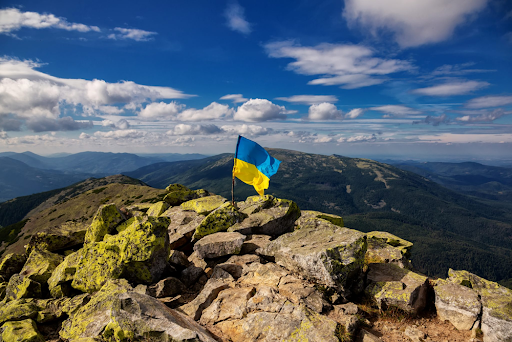
The blue-and-yellow flag of Ukraine flying high in the Carpathian Mountains, visually symbolizing the blue sky above golden fields and the nation's resilience.
Contemporary Meaning and National Symbolism
Ukraine’s national flag consists of two equal horizontal bands: blue on the top and yellow on the bottom. In modern interpretation, this simple bicolor vividly reflects Ukraine’s natural landscape and aspirations. Together, they form a poetic image of “a peaceful sky above golden wheat” – a vision of serenity and prosperity.

Beyond its natural symbolism, the blue and yellow have long been tied to Ukraine’s national identity, even during periods when the flag was banned under Soviet rule. Today, these colors are a familiar sign of the fight for freedom and democracy, unity and resilience, recognized worldwide. In peace, they suggest optimism for the country’s future; in conflict, they serve as a visible mark of defiance and determination.
Historical Roots
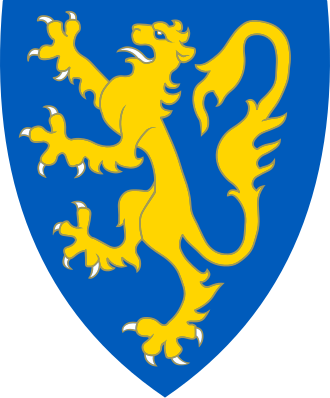
The blue-and-yellow color scheme, now synonymous with the Ukrainian national flag, has roots stretching back to the medieval era in the lands of historical Ruthenia. In particular, the principalities centered around Galicia–Volhynia (Ruthenia) and the region of Lviv provide some of the earliest recorded instances of blue and yellow banners and heraldic emblems. These colors appeared on princely coats of arms, city seals, and military standards long before they were adopted as modern national symbols.

The earliest blue-and-yellow banners in the principalities of Ruthenia and Lviv emerged in the 13th–14th centuries through heraldic lions and eagles on azure fields. These symbols carried deep feudal and dynastic significance, and their visual splendor ensured they were recorded in seals, coins, and chronicles. Their symbolic power – representing Rus’ royal heritage, courage, and the riches of the land under an open sky – resonated through the ages, ultimately shaping the iconography of an independent Ukraine in the 20th century. The medieval colors of blue and yellow, born in an era of princes and knights, thus live on as an emblem of national identity and historical continuity for the Ukrainian people.
Heraldic Principles: “Color on Metal” Correctness
The Ukrainian flag follows a key European heraldic rule: place a color over a metal for clear contrast. In heraldry, blue (azure) is a color and yellow/gold (or) is a metal. The flag’s blue-over-yellow layout avoids the “color-on-color” or “metal-on-metal” clashes, making it visually distinct and historically proper. The choice of these colors also reflects historic heraldic symbols of Ruthenia and Lviv, where azure fields and golden lions were prominent. Many European banners share this design logic, but Ukraine’s flag blends heraldic correctness with its modern symbolism of sky over wheat.
From Lviv to Kyiv: The Path to Standardization
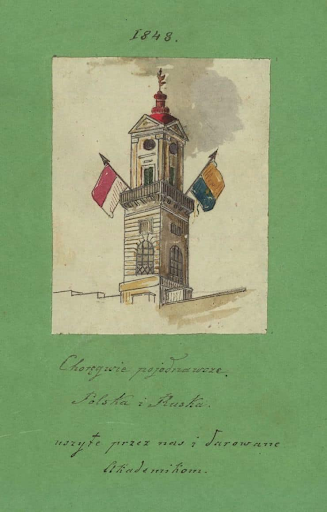
In 1848, during the revolutionary wave known as the Spring of Nations, Ukrainians in Austrian-ruled Galicia raised a yellow-over-blue flag over Lviv's city hall. This was a period of political upheaval across Europe, as various peoples demanded national rights, constitutional governance, and greater freedoms. In Galicia, the creation of the Main Ruthenian Council marked the first organized political representation of Ukrainians under Habsburg rule. The yellow-over-blue flag, inspired by the historic heraldry of the region, symbolized the awakening of national consciousness, though the order of colors varied and no official standard had yet been set. The event linked Ukraine’s medieval symbols with a modern nationalist movement, laying the groundwork for the adoption of the blue-and-yellow flag in the 20th century.

Between 1917 and 1922, Ukraine experienced rapid and often violent shifts in political power, yet the blue-and-yellow national colors persisted as a unifying emblem of Ukrainian statehood. The turning point came with the Ukrainian People’s Republic in 1917–1918, when the flag was officially adopted as blue over yellow. The flag was first formally adopted by the Ukrainian Central Rada in 1917 as the flag of the Ukrainian People’s Republic (UPR).
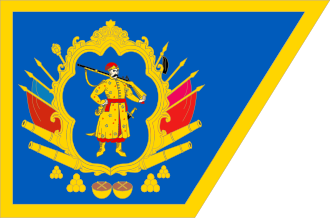
Mykhailo Hrushevsky, Ukraine’s preeminent historian and first head of the Central Rada, played a decisive role. A passionate advocate for national continuity, Hrushevsky promoted the blue-yellow flag as the legitimate symbol of Ukraine, as a link to historic Cossack-era traditions and earlier heraldry, blue fields and golden lions of Galicia, and the poetic image of sky above wheat fields. Under his influence, the Central Rada issued the resolution formalizing the flag's order.
Historical Continuity Through Tumultuous Times
Even as governments changed—from the Central Rada to the Hetmanate of Pavlo Skoropadsky in 1918, then to the Directory under Symon Petliura, and later to the short-lived Western Ukrainian People’s Republic (ZUNR)—the same blue-over-yellow flag remained in use, reflecting a shared national identity that transcended leadership disputes.
This continuity was remarkable given the political chaos. During the Hetmanate, the regime preserved the blue-and-yellow banner alongside the trident emblem, seeking legitimacy by aligning with the symbols of the earlier Rada. When the Directory overthrew Skoropadsky, it too retained the colors, and the ZUNR in Galicia adopted them independently before uniting with the UPR in the Act of Unification of 1919. Even when Bolshevik forces temporarily occupied Ukrainian territory and imposed red Soviet banners, the blue-and-yellow flag continued to be flown in exile, on military standards of the UNR Army, and in liberated areas.
By the time the UPR government retreated abroad in 1920–1921, the blue-and-yellow flag had already become entrenched as the core visual identity of Ukrainian independence, recognized both domestically and among the diaspora. Its uninterrupted use across different Ukrainian governments during 1917–1922 gave it a legitimacy and symbolism that outlasted each regime—laying the foundation for its revival in 1991 as the state flag of independent Ukraine.
During the Soviet era, the blue-and-yellow flag—associated with the 1917–1921 Ukrainian People’s Republic—was outright banned in Soviet Ukraine. Displaying it could lead to arrest, imprisonment, or worse, as it was officially deemed a “bourgeois nationalist” symbol. Despite this, the bicolor survived underground and in exile. Ukrainian communities abroad, particularly in North America, Western Europe, and Australia, continued to raise it at cultural events, church gatherings, and political rallies. Inside Soviet Ukraine, it appeared covertly: hand-sewn flags were unfurled during clandestine commemorations of historical dates such as the anniversary of the 1918 independence proclamation or the 1950s uprisings. Even at great personal risk, dissidents and members of the national underground used the blue-and-yellow banner as a quiet act of defiance, keeping its memory alive for future generations.

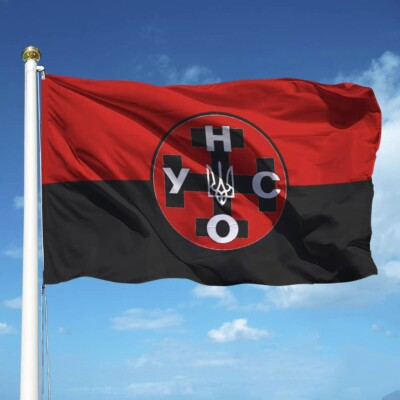
The red-and-black flag—symbolizing “blood and soil”—was the emblem of the Organization of Ukrainian Nationalists (OUN) and the Ukrainian Insurgent Army (UPA), who fought against both Nazi Germany and Soviet rule during and after World War II. To the Soviet authorities, it was an even greater threat, representing armed resistance and uncompromising anti-communism. Official propaganda demonized it as the banner of “fascist collaborators,” while possession or display of it was treated as a grave political offense. Nevertheless, in western Ukraine, especially in rural areas, the red-and-black flag appeared secretly on UPA grave sites, in underground publications, and during nighttime commemorations. In the diaspora, it flew openly at demonstrations, alongside the blue-and-yellow flag, as a symbol of the ongoing struggle for an independent Ukraine. Both flags thus endured as parallel symbols of freedom—one representing the statehood tradition, the other the armed resistance—until they could be raised freely again after 1991.
The Return of the Original Ukrainian People’s Republic Flag to Independent Ukraine
In August 1992, one year after Ukraine declared independence, the Ukrainian People’s Republic (UPR) government-in-exile—which had preserved the symbols and legacy of the 1917–1921 republic—formally transferred its authority and regalia to the leaders of the new state. Mykola Plaviuk, the last president of the UPR in exile, came to Kyiv with the historic blue-and-yellow national flag, the Great State Seal, and the Presidential Badge of Office. In a solemn session on 22 August, he declared the mission of the exile government complete and recognized independent Ukraine as the successor to the UPR.
On 24 August 1992, in a ceremony at Mariinsky Palace attended by President Leonid Kravchuk, parliamentary and government leaders, Plaviuk presented the UPR’s flag and other regalia to Ukraine’s authorities. The banner—used by the 1918 republic—was both a tangible relic and a potent symbol of continuity between Ukraine’s first and current independence. The gesture marked the voluntary dissolution of the exile government and the symbolic “return” of the UPR’s statehood to its homeland after more than 70 years abroad.
The handover carried deep legal and symbolic weight. Though Ukraine’s 1991 independence act did not legally position it as the UPR’s successor, the ceremony affirmed a historical continuity of statehood and restored the national colors suppressed under Soviet rule. In Ukrainian memory, the moment is remembered as the symbolic unification of the revolutionary-era republic with the modern state—a closing of the historical gap between 1920 and 1991, and a powerful reminder of Ukraine’s long, deliberate struggle for sovereignty.
The Symbol of the Fight for Independence, Freedom, and Democracy
In the 21st century, both the blue-and-yellow and red-and-black flags re-emerged in Ukraine as powerful symbols of the fight for freedom and independence. During the Orange Revolution of 2004, the blue-and-yellow national flag dominated Kyiv’s Independence Square, carried by hundreds of thousands of protesters demanding free and fair elections. It was joined at times by red-and-black banners brought by nationalist groups, their presence underscoring a readiness to defend democratic choice against political manipulation. The blue-and-yellow in 2004 symbolized unity across regions, while the red-and-black hinted at a deeper historical continuity with the uncompromising resistance of the past.
In the Revolution of Dignity (Maidan) of 2013–2014, both flags again flew side by side. The national flag draped barricades, adorned helmets, and waved over the crowds as a visible claim to Ukraine’s sovereignty and European future. The red-and-black banners of the OUN–UPA tradition were especially prominent among self-defense units on the square, signaling a willingness to resist tyranny by force if necessary. After Russia’s occupation of Crimea and war in Donbas began in 2014, both flags moved from protest squares to the front lines—stitched onto soldiers’ uniforms, flown from trenches, and painted on armored vehicles as emblems of a nation under attack.
Since the start of Russia’s full-scale invasion in February 2022, the blue-and-yellow national colors have been visible on a scale unprecedented in Ukrainian history—both on the battlefield and across the world. Inside Ukraine, they became an immediate symbol of defiance. In cities under attack, residents hung flags from balconies, painted curbs and fences in blue and yellow, and draped them over checkpoints and sandbagged positions. In occupied territories, people risked arrest to display small ribbons or stickers in the national colors, or to paint blue-and-yellow stripes on utility poles and walls as covert acts of resistance. In newly liberated towns such as Bucha, Irpin, and Kherson, raising the flag over administrative buildings or main squares was often the first public act after Russian forces were driven out—an unmistakable declaration that Ukraine had returned.
Abroad, the national colors became a unifying symbol for global solidarity with Ukraine. Landmarks from the Eiffel Tower to the Empire State Building were lit in blue and yellow. Millions of people in dozens of countries took to the streets for pro-Ukraine rallies, waving the flag or wearing scarves, ribbons, and armbands in the national colors. Sports teams, musicians, and public figures displayed the flag at events, while shops and private homes in cities far from Ukraine put blue-and-yellow banners in windows as gestures of support. These colors, once primarily a domestic emblem of statehood, have become instantly recognizable worldwide as the sign of a nation resisting aggression—standing for sovereignty, freedom, and the determination to survive.
🇺🇦 Fun Facts About Ukraine’s Flags and Colors
Sky Over Wheat – and Heraldry Rules: Blue-over-yellow isn’t just poetic—it’s heraldically correct: “color over metal” (blue = color, yellow = metal).
Oldest Roots: Dates back to the 13th-century coat of arms of the Kingdom of Galicia-Volhynia—golden lion on an azure field.
1848 Revolution Debut: First modern blue-and-yellow flags raised in Lviv during the Spring of Nations.
One Flag, Many Governments (1917–1922): All Ukrainian governments of the revolutionary era used the blue-and-yellow.
Banned, but Not Forgotten: Under Soviet rule, possession could mean arrest—flag survived in exile and underground.
Red-and-Black Symbolism: The OUN–UPA’s red-and-black banner symbolized armed resistance.
Returned from Exile: In 1992, the Government-in-Exile brought its preserved flag and regalia to independent Ukraine.
World Record Flag: In 2014, Kyiv saw one of the world’s largest blue-and-yellow flags—over 60 meters long.
Painted Resistance: In 2022, occupied towns showed defiance with blue-and-yellow street art.
Global Landmark Glow: Since 2022, landmarks from Niagara Falls to the Sydney Opera House have shone in blue and yellow.
